Our mission is to improve the quality of life for BIPOC who are affected by IBD, Digestive Disorders and associated Chronic Illnesses; through Community, Research, Education, and Advocacy.

OSTOMY AWARENESS DAY
A Journey Through The Bag

OCTOBER 4, 2025

OCTOBER 4, 2025

Join us to build ostomy awareness!


“A Journey Through The Bag”


Ostomy Awareness Day, held annually on the first Saturday of October, is an opportunity to celebrate ostomates and spread ostomy awareness.

According to the National Institution of Health, about 100,000 people have ostomy surgery of the bowel each year. A little over 15% of ostomies in general are due to inflammatory diseases and obstructions. While ostomy surgery helps patients better navigate their illnesses, there is still more work to do to bring awareness, support, and an increased quality of life to our ostomates and their care partners.

Show your support by spreading ostomy awareness.

References:

Hendren S, Hammond K, Glasgow SC, et al. Clinical practice guidelines for ostomy surgery. NIH Diseases of the Colon & Rectum. 2015;58(4):375–387. doi:10.1097/DCR.0000000000000347

BMHC Health Services Research: Who are the ostomy patients and caregivers attending Portuguese community pharmacies? A cross-sectional study

Image

Ostomy Academy Webinar: Cultural Influences on Ostomy Life– Celebrating World Ostomy Day 2025

Ostomy surgery and conditions like IBD can come with stigma. In this conversation, we’ll address the unique challenges people may face within their communities—based on their ethnicity, culture, sexual orientation, or gender—and explore the support systems that can help. Join us to share, learn, and connect.

Panelists include:

  • Dr. Neilanjan Nandi, MD, FACP
  • Tina Aswani-Omprakash, MPH
  • Daniel Garza
  • Ashley Turner
  • D’andre Hardy

Beyond the Bag

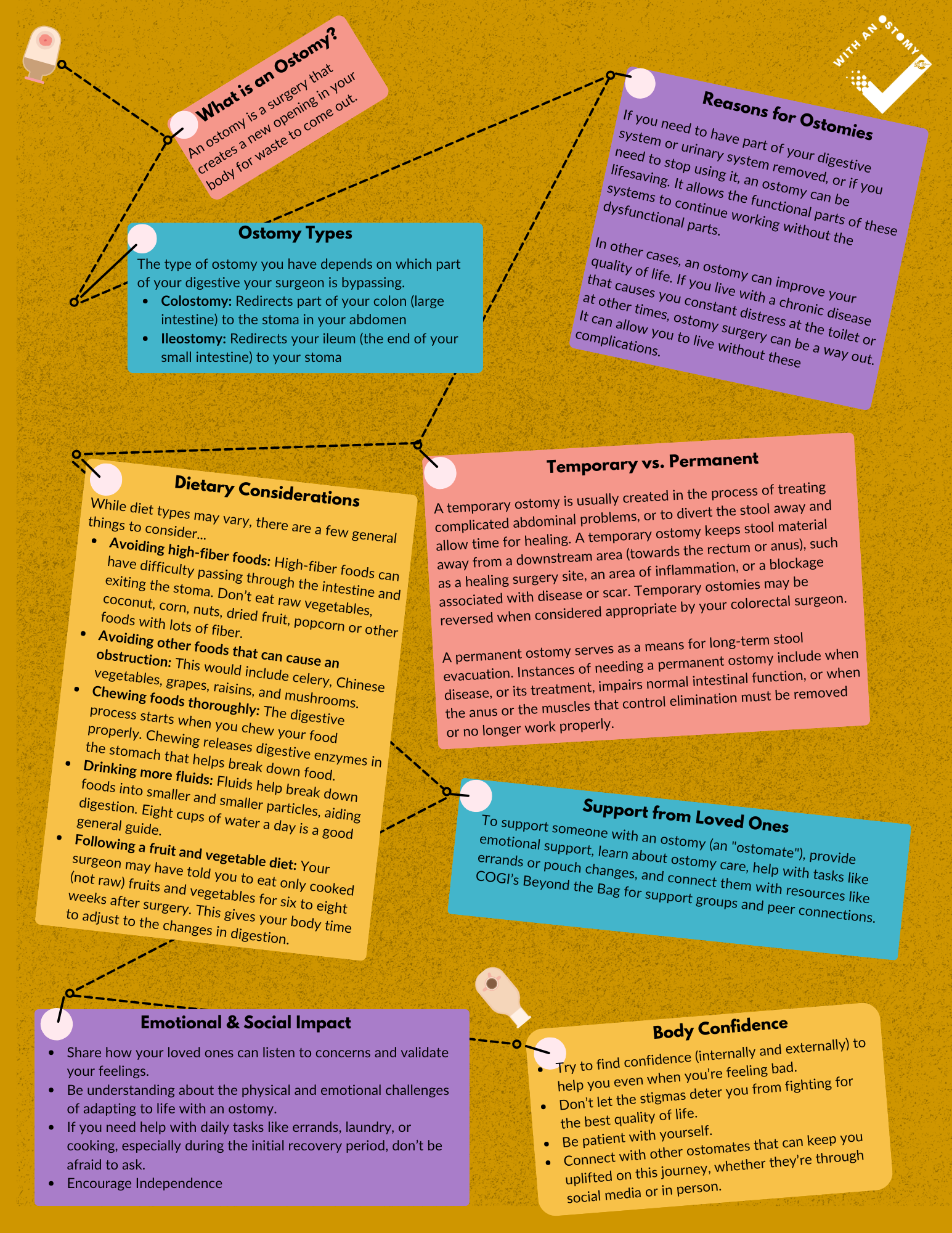
Beyond the Bag is COGI’s signature year-round initiative dedicated to improving education, visibility, and support for people living with an ostomy. The program centers diverse patient voices, reduces stigma, and equips patients and caregivers with the tools to thrive—beyond surgery, beyond stigma, and beyond the bag.

To our Ambassadors & Community Members, thank you for using your superpower–Your Voiceto bring awareness to the diversity in ostomy patients & families.

Help UOAA Make October 4th, 2025 World Ostomy Day Across the U.S.

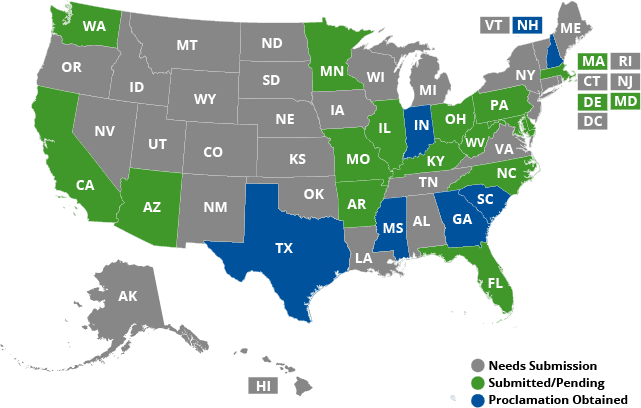
In our ambassador program, ostomates make up more than 30% of the group! With constant efforts to amplify ostomy awareness through Beyond the Bag, COGI is encouraging our ambassadors and community members to join in the effort to make October 4, 2025 World Ostomy Day.

So far our community has assisted in obtaining proclamations in 2 states, Texas and Mississippi, and that’s only the beginning!

Ostomy Facts From The Past...

  • The first recorded ostomy procedure dates back to the 1700s – In 1710, Alexis Littre, a French surgeon, described creating an artificial opening in the intestine to treat intestinal obstruction. Though not identical to modern procedures, this laid the groundwork for future ostomy surgeries.
  • World War I and II advanced ostomy care – Soldiers with abdominal injuries often needed emergency ostomies. The challenges of infection and skin irritation during wartime accelerated research into better surgical techniques and materials for stoma care.
  • Before modern appliances, patients used makeshift devices – In the 19th and early 20th centuries, people with ostomies often relied on rubber bags, metal tins, or even glass jars strapped to their bodies. Leaks, odors, and infections were common, making life extremely difficult.
  • The modern ostomy pouch wasn’t invented until the 1950s – Danish nurse Elise Sørensen created the first disposable ostomy pouch in 1954 to help her sister manage a stoma. This innovation revolutionized quality of life for ostomy patients worldwide.
  • Ostomies were once considered a “last resort” surgery – Until the mid-20th century, many surgeons hesitated to perform ostomies, believing patients wouldn’t survive long afterward. Advances in antibiotics, anesthesia, and stoma care proved otherwise.
  • Stoma care nurses became a specialty in the 1960s – The emergence of enterostomal therapy as a nursing specialty gave ostomy patients professional support, education, and advocacy, reducing stigma and improving outcomes.
  • The first ostomy support groups formed in the 1950s – As ostomy surgeries became more common, patients started gathering for peer support. The United Ostomy Associations of America (UOAA) grew out of these grassroots networks and helped reduce isolation.
  • Ostomates were historically excluded from some jobs – Before modern pouches, employers sometimes refused to hire people with ostomies, particularly in physically demanding or public-facing roles, due to concerns about reliability and hygiene.
  • The rise of ostomy advocacy paralleled the disability rights movement – In the 1960s–70s, patients and nurses pushed back against stigma, framing ostomies not as shameful but as life-saving medical solutions that allowed people to live fully.
  • Fashion had to adapt for ostomates – Before ostomy-specific garments were designed, patients often altered their own clothing or wore oversized outfits to hide bulges from early appliances. Specialized ostomy belts and underwear became more available in the late 20th century.
  • Ostomy stories were once almost invisible in the media – For decades, films, books, and TV avoided the topic altogether, reinforcing silence. Only recently have more open conversations and visible advocates (including athletes, models, and influencers with ostomies) emerged to normalize the experience.

Sources:

  1. Alexis Littre (1710, early ostomy concept) Williams NS. Historical landmarks in operations on the colon: surgeons courageous. Dis Colon Rectum. 2005;48(8):1736–1748. PubMed | Alexis Littré entry. Wikipedia
  2. Elise Sørensen invents the first adhesive disposable pouch (1954) Elise Sørensen entry. Wikipedia| Coloplast history of innovation. Coloplast| Valente M, et al. Evolution of Ostomy Pouch Design. J. Compos. Sci. 2024;8(10):388. MDPI
  3. Primitive appliances (glass, metal, rubber bags) before modern pouches Valente M, et al. Evolution of Ostomy Pouch DesignMDPI| “History of stomas.” Stomaatje.com
  4. Enterostomal therapy nursing specialty (1960s) WOCNCB – history of certification and ET nursing. WOCNCB.org| Erwin-Toth P. Honoring the 100th Birthday of Norma N. Gill, the World’s First Enterostomal Therapist. Adv Skin Wound Care. 2020;33(6):282–284. LWW Journal
  5. Early support groups (1950s, Mount Sinai Hospital, later UOAA) Turnbull RB, Weakley FL. The Development of Ostomy Rehabilitation. Dis Colon Rectum. 1981;24(1):1–5. PubMed abstract| UOAA mission & history. UOAA.org
  6. Ostomies as “last resort” until mid-20th century Turnbull RB. Ostomy care: Foundation for teaching and practice. Dis Colon Rectum. 1999;42(3):374–380. PubMed (discusses mortality/morbidity before 1950s).
  7. Impact of World War I & II on ostomy care No direct scholarly source found tying wartime injuries specifically to ostomy innovation. General history of wartime surgery exists, but ostomy references are scarce.
  8. Employment discrimination against ostomates No primary study found. Evidence mostly anecdotal from patient accounts in support group histories.
  9. Ostomy advocacy paralleling disability rights (1960s–70s) WCET history. WCETN.org (growth of international advocacy). Explicit linkage to disability rights is more interpretive than documented.
  10. Fashion/clothing adaptations Suportx blog on evolution of ostomy garments. Suportx.us

5 Questions on Dispelling Ostomy Myths

There are countless assumptions and narratives created around ostomates and ostomies. There are added complexities when that ostomate has a digestive disease like IBD. On this segment, COGI Ambassadors have a discussion about ostomy related myths they hear about and give the real about what “normal” looks like for them.

Join Our Community

Find us on the following platforms and join the conversation!

Subscribe to our newsletter!

Never miss an update. Receive periodic emails from us, and cancel at any time.

This field is for validation purposes and should be left unchanged.